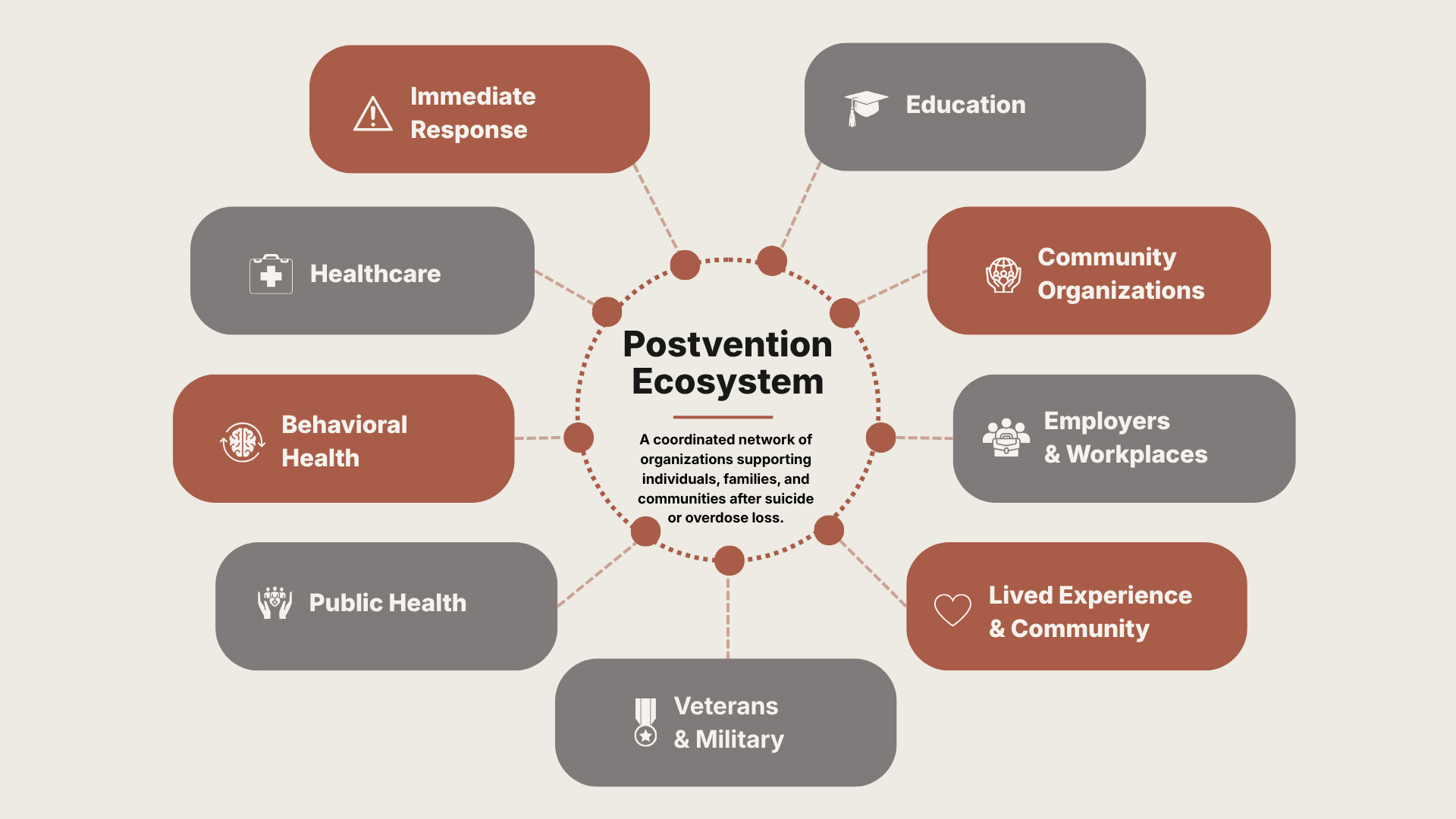
rethinking how systems respond to suicide loss
prevention begins with the bereaved.
suicide loss survivors hold critical insight into how systems respond to suicide.
the postvention project helps organizations translate that insight into training, strategy, and structures — so that supporting the bereaved becomes a core part of prevention.
the impact of suicide extends far beyond a single loss.
97M+
people are newly bereaved by suicide each year — globally
5–135
people are directly and indirectly impacted by every suicide death
3.6x
increased risk of suicidal ideation among suicide loss survivors
· WHO, 2024 · Pitman et al., 2016 · Cerel et al., 2019
postvention is upstream prevention.
when institutions fail to support the bereaved, prevention fails with them.
the infrastructure gap
every year, millions of people are left without adequate institutional support.
organizations — employers, universities, first responders, clinical practices — are often expected to respond well, but rarely have the training, protocols, or systems to do so meaningfully.
the result is a self-perpetuating cycle: undertrained responders, unsupported survivors, and a prevention opportunity lost.
unsupported suicide bereavement elevates survivors’ risk for suicidality
leading to additional suicide deaths
creating new populations of bereaved survivors
this is not a service gap.
it’s a self-perpetuating cycle.
our work
for clinicians
evidence-based training for clinicians and counselors on the specific needs of suicide loss survivors — what they experience, what helps, what harms, and how clinical responses shape long-term outcomes.
interrupting this cycle requires more than awareness — it requires structure.
the postvention project works with organizations to build the training, protocols, and systems needed to respond to suicide loss with competence and care.
for organizations
protocol development and implementation support for organizations navigating suicide loss — from immediate response through long-term institutional recovery.
for systems & communities
keynotes, workshops, and consultation that advance suicide bereavement as a public health priority across institutions and communities.
who this work supports
suicide loss does not happen in isolation — it moves through workplaces, campuses, communities, and care systems.
this work focuses on strengthening how institutions respond to suicide loss.
employers & hr
supporting workplace teams after suicide loss — building bereavement protocols and equipping managers to respond with clarity and care.
higher education
helping colleges and universities build postvention infrastructure that supports students, staff, and the broader campus community.
first responders
training and protocol support for law enforcement, fire, and emergency services navigating repeated exposure to suicide.
clinical providers
consultation and training for therapists and clinical teams navigating the complexities of suicide loss.
about
sara l. shelton is the founder of the postvention project and holds a BA in business administration and an MS in gerontology. she has an extensive background in aging services leadership, managing and troubleshooting at retirement communities.
wanting to share that expertise with families seeking care options, sara founded and operated an eldercare consulting business before building a decade of operational and program leadership across healthcare, consulting, and technology — learning firsthand how systems either support or fail people at their most vulnerable.
that experience shaped how she thinks about care: not as a transaction, but as a structural responsibility. it also included developing a comprehensive trauma-informed training program for peer support contractors — deepening her understanding of how adult learning, lived experience, and clinical knowledge intersect in practice.
in late 2019, her sister heidi died by suicide. navigating that loss, particularly during the pandemic, exposed how little meaningful support exists for suicide loss survivors — and how much of what does exist fails to draw on the one thing that cannot be replicated in a clinical training program: lived experience.
that gap is what drives this work.
* the use of lowercase lettering throughout this site is intentional — it honors heidi.
let’s talk.
postvention infrastructure isn't crisis response. it's preparation.
if you're ready to build it, we'd welcome a conversation.